Wednesday, May 10, 2017

School Choice - What are the K12 numbers in 2017?

This is a fun exercise to figure out the numbers.
It's odd to me that there isn't more work on this top down view....
This is just one way of estimating, I'd like to dig in and cross reference a few data sources on charter school statistics as well as virtual school stats.

Estimate of  K12 in 2017
Total                       57,623,100
Public Schools:      50,477,000    An estimate of 3,240,000 in charters.
Homeschooling:      2,088,600  
Private Schools:      5,057,500

Trends:  
Charter School growth has been 180K per year.
Private schools are shrinking by 85K per year.
Homeschoolers are growing by 71K per year.

Data Sources - This data is built on rough estimates projecing forward historical trends on a straight line basis with no correction for population size changes.


Public Schools - NCES - Projection of 2017 by NCES
Charter school - nces - 2,700,00 in 2014. Growth from 0.9 to 2.7 2004 to 2014.  This is 1.8 over 10 years or 180K new each year on a straight line. Adding three more years or 3 x 180,000 produces an estimate for 2017 of 3,240,000.   Data from Charter school groups could be used but
Private Schools - NCES - The number declined from 6,073,000 in  2005 to 5,396,00 in 2013, a decline of 677,000 over 8 years or 84,625 per year.  Projecting the same absolute number loss per year, an estimate of a loss of 338,5000 over 2014-2017, 5,057,500 in 2017
Homeschooling: NHES. Estimate of 2,088,600 based on 1.77M (2012) increased by 18% since that was the growth reported over the previous 5 year period. This is projecting a historical trend forward.

The NHES survey says that 1.77 million students were homeschooled in 2012, which is an 18% increase since the last study in 2007. In fact, the number of homeschooled children has been steadily increasing each year, and is expected to continue to rise. This is an increase of what number per year????

NHES says 850,000 students in 1999 to 1,773,000  students in 2012: 923,000 over 13 years 0r 71K per year. 5 x 71K is a 355,000 increase or  estimate of 2,128,000.  This approach is 100K more than the other one for estimating.
The most recent Federal Government study concluded that about 3.4% of the K-12 students or 1.77 million students were being homeschooled in the United States as of spring 2012. The study was performed by the National Household Education Survey Program (NHES) and the results are available on the Dept of Education Website as part of the National Centers for Educational Statistics.

x

Discussion NCES
CERN _ here are more than 6,800 charter schools serving nearly 3 million children across the country (February 2016)

Saturday, January 30, 2016

NEW SAT: HOW TO PREPARE?


Those great people in educational testing have, after years of losing market share to the ACT,  redesigned  the SAT!


The new SAT is much more of an achievmeent test than the old idea of some sort of aptitude or IQ test. Basically, it tests what you've learned.

The new SAT has three sections: Math, Evidenced-Based Reading and Writing. 
The new SAT has an optional SAT Essay.

 Students have 3 hours to complete the Evidence-Based Reading and Writing sections and the Math Test, and another 50 minutes to complete the optional SAT Essay. 

The Prepworks software helps student prepare by both familiarizing them with the test questions, providings strategies for approaching the questions but most importantly, it actually builds the skills that the SAT tests. In some ways, its a course totally focused on the skills that the SAT will measure.

The Khan Academy approach only deals with getting students familiar with those types of questions

Sunday, November 22, 2015

Local Partnerships, Giving Back

Heh, I was just updating the blog on VocabularySpellingCity about the Community Partnership and I thought that I would mention it here.

I was looking at an article called: Community Partnership with Broward County Public Schools
VocabularySpellingCity and Science4Us, a Science Elementary Program are proud community partners of Broward County Public Schools as part of our strategy of giving back to our community on an ongoing basis.  The 2014-2015 school year has been full of exciting events, such as the Hour of Code Presentations, STEM Olympiad, Career City at Dillard Elementary, Career Day for the SuperCoders at our headquarters, and the FAT Village Art District Dillard Parade!  The article generally recaps 2014-2015's  community partnership events.

This year, the blog talks more about general issues in education:

Saturday, November 21, 2015

Why do teachers say they work for the school board?

I'm perplexed by how many teachers I find who talk about working for the school board. It seems like a weird thing to me.

Realistically, teachers report to their principal. The principals work for the superintendent. The superintendent is selected by the board.

In business, most people when asked who they work for, will either cite their boss or the president/CEO of the company. I've never heard of anyone is business talk about the board of directors as who they work for.

In non profit universities and hospitals, I imagine people work for the dean or president or executive director.

What is it in some parts of the country or some school districts that this language of working for the school board has taken hold?  I'm suspicious that it's a load of C***.  Specifically, I think it's almost Orwellian in that it highlights the role of a board of frankly amateurs and denigrates the role of the professional superintendent.

Any thoughts anybody? Any insight?

Tuesday, November 3, 2015

Words Their Way, Reading Programs, and Literacy Curricula

For a long time there's been different approaches to teaching recently. Recently, the Reading Wars have ebbed as most schools settle into a system which relies in large part on classic phonics but for decades before that, the Reading Wars between the Whole Language and Phonics people raged.

Currently the big fights in literacy curriculum have more to do with the increased demands (ie rigor) of the Common Core and how the heck to teach it.  Schools are struggling to develop skills at teaching close reading and the ability to do sophisticated synthesis and comparisons between two or even three informational texts.

But in the background, there remains some big disagreements on the role of curriculum, standards, and technology.  Some people still believe in and rely on the classic basal readers which provide a recipe and all the materials for each grade level. Reading Street, Journeys, and Wonders reign as leading reading programs. An alternative approach which has had great traction across the country is Words Their Way (now it belongs to Pearson) which has students sorting out sounds and cutting them into little pieces.

These are are very traditional programs in terms of delivery so they often get paired with slick modern technology solutions such as VocabularySpellingCity.  Here's a success story on the mechanics of combining  Words Their Way with VSC and a research study that talks about how the high effectiveness of pairing VSC with WTW:

VocabularySpellingCity is the only resource we've found that has the capacity to be paired with the Words Their Way approach to accomplish the goals of spelling, phonics and vocabulary instruction,” write Nielsen-Winkelman and West. “As educational technologies emerge and evolve, it is essential to use a critical eye toward the specific tool affordances when making decisions about instructional practice.”
The article, “Improving Word Study — Moving Beyond Paper and Pencil to Transformative Educational Technology,” was published in the June 2015 issue of Literacy Special Interest, the Journal of the International Society for Technology in Education’s (ISTE) Literacy Professional Learning Network, in conjunction with the ISTE 2015 Conference.
Creating A Streamlined Process

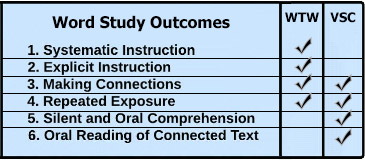
Nielsen-Winkelman and West identified six key components for phonics, vocabulary and spelling instructional practices and used them to evaluate VocabularySpellingCity (VSC) and Words Their Way (WTW): (1) systematic instruction, (2) explicit/direct instruction, (3) making connections, (4) repeated exposure, (5) comprehension of material read silently or orally, and (6) oral reading of connected text.
Word Study Outcomes using VocabularySpellingCity and Words Their Way
Credit: Nielsen-Winkelman, Tiffany and West, Lynnea

Wednesday, October 14, 2015

Education and Technology - Notes for SFTA

John on Technology in Education


Technology in Education: Big picture. Education is a process. It takes raw materials, does something to them, ie "educates" them, and provides an output of people ready to be productive adults.
What's changed with tech and the modern world generally? Only everything

1.  The desired output.  Handwriting, arithmetic skills, and knowledge losing their value to employers. And the traditional 30-40 year career at a company died in the last few decades.  New economy requires independence, constant learning and networking, new ways of researching and communicating.

2. The input. The kids of today are so different than not just their parents but their older brothers and sisters. At a conference 4 years ago, there was a powerful slide where two kids  in strollers were shown. Both were holding ipads. Tehre were a series of funny captions about this one can't talk, this one can't walk, both still wear diapers. And then they showed the software that the kids were playing with.  It was stunning. Today, that same point has no emotional power. Of course, diapered kids use iPads.  But those kids are NOT going to react to  a 30 minute lecture by a teacher the way their older siblings did. Never mind like their parents or grandparents.  And despite big pharma, I don't think we're going to drug them all as if they had ADHD..

3.  The process of education. Lets just point out that while most industries can track their increase in productivity. It's often in the news about how the economy overall produced more output for the same amount of labor, education is one of very few sectors that has NO record of productivity increases. Techniques and organization and bureaucracy have all combined to produce no productivity increases.

Quick Intro on me:
Spent my 20s in teh big business consulting firms. Loosely defined. That includes Price Waterhouse consulting and being a Peace Corps Business Advisor.

At 30, I went west to silicon Valley. Worked in 3D graphics at Silicon Graphics, then in video games at 3DO.  Went to London for 6 years including 2 running a video game development company. I went platinum as a playstation game producer.

Some family and business stuff happened and I ended up jobless in South Florida. I started my company in 2004 and have been running it ever since. It was a living room startup.

We now have 60  people here in the office. Another 25 around the country. Steady growth of around 20%.

One half o the business is Our homeschool products are Time4Learning and Time4Writing.  For the first 5 years, I focused on a new sector in education: Homeschoolers.  They are 3% of the K12 population and were probably the first K12 sector to get to 1:1 computing.

While that part of the business continues to prosper, I've focused on the school market for the last few years.

VSC:  Describe it by customer need. Imagine.

S4U:  technology for the sake of science education.

Schools are torn between traditional instincts, use of technology to improve what they are now doing but do it better, and a brave new world in which instead of batching students thru grouped by age in which the pace and teaching focuses on the middle of a bell curve of needs, using technology to provide people with challenges and skill building appropriate to their appetites and capability.

Most powerful thing that I've learned from homeschooling is the magic of choice. And the poison of regimentation and inappropriate work. Kills the interest and motivation.

Saturday, August 8, 2015

Can Google Classrooms replace a LMS like Moodle for some uses?

We use Moodle as a LMS for some of our remote learning work.  We don't love it. I'm looking for an alternative. Right now, Canvass by Instructure is the hot LMS but it seems to have gone from free open source to commercial and pricey. Their website is full of "Try it Free" and if you have questions, "Fill in this form" but there's not mention of pricing anywhere which makes me think it's pricey!

I've heard noise about Google Classrooms and I'm trying to ascertain what it is and what it isn't.

Google says:  Classroom is a new tool in Google Apps for Education that helps teachers create and organize assignments quickly, provide feedback efficiently, and easily communicate with their classes. More....It's a suite of productivity tools...

Classroom is only available for Google Apps for Education users at this time.

Here's my question. Can I use Google Classrooms instead of Moodle as a way to give out assignments, collect them, grade them, return them? 

I asked on a Google forum and was told:

"...  Google Classrooms does not offer a core comprehensive grade book or other traditional features found in other LMS solutions.

I asked whether Google Forms could be used with Classroom as a way to get assignments from students.

Answer: "there currently isn't an embedded Forms or Quizzing feature within Google Classroom but using Google forms is still a very useful way to collect data or quiz students."

When I checked on Google forms to see it could handle the technology enhanced features required for CCSS assessments, I see that Google Forms supports these data types:
Google Forms Supports These Inputs
The test sounds like a short answer input. Paragraph is longer. Multiple choice is what it sounds like.  However, I don't see any way to use this for automated grading.  I can't imagine why Google hasn't added a basic set of LMS features since it set up teachers and classrooms. I wonder if they would accept a third party to develop it..

Here's the Google forum discussion:


Does Moodle Support the Technology Enhanced Items for Assessment in the Common Core

Does Moodle's LMS support the seven new technology enhancements to  Common Core tests?

One user of Moodle (Plymouth University, UK) says that these types of questions are available in Moodle: (Links go to Moodle documentation)


What are the technology enhancements to  Common Core tests from PARC and Smarter Balance.  Edudemic has a good article which reviews

1. Drag and Drop: This item type does exactly what the name implies. Students need to drag an item from one part of the screen to another. IS it click, drag, click to drop?
2. Multiple Select: This item type is most similar to a traditional standardized test format. It is a multiple choice question, but instead of just one correct answer, there are many, and students must choose all of them to get the question correct.

3.Text Selection/Highlighting: This item type requires students to click on words, phrases, or entire sentences as a way to answer questions about specific parts of a text.

4. Equation Builder: This item is like a mini word processor that includes specialized mathematical symbols, ranging from simple division signs to more complex trigonometric symbols, such as sin and cosine. WILL THIS SHOW UP ON LANGUAGE ARTS TESTS?

5. Drop Down Menus: This item type includes a menu that expands when clicked on. From the expanded menu, students can see possible answer choices. They click on the word or number that completes the answer, based on context.

6.Constructed Response: This item is an embedded word processor. It has simple word processing functionality, like the ability to change text size and style and to cut, copy and paste.

7. Multiple Part Question: This item is not a new item type; rather it is a new way of organizing items. The Multiple Part Question asks related, tiered questions using a combination of other enhanced item types.

The new generation of advanced standards, mostly the Common Core, has a new generation of tests, mostly from Smarter Balance and PARC. There are of course the Texas and Florida versions of the standards and a few others.

The FL standards are different than the Common Core standards in a number of truly insignificant ones. But, by Governor Dick Scott demanding that Florida not use the Common Core, he becomes a hero to some people on the right. He also  forces all the teachers and educators in FL to spend millions of hours trying to slightly rejiggle all those great common core materials into something they can use to support their work by doing a crosswalk of the national materials to their local needs.

Who are the big technology education companies with the expertise that I need:

Moodlerooms
Classroom Revolution
Webanywhere


Sunday, May 10, 2015

TED talks - my favorites

Dame Stephanie Shirley - Why ambitious women have flat heads

Anand Giridharadas: A tale of two Americas....


Not as good...
Cameron Russell: Looks aren't everything. Believe me, I'm a model.

Sunday, April 5, 2015

Dillard Elementary School

One of the things that I like best about my job (I run an edtech company) is that I feel that I have a front row seat to history. I'm watching and participating in a historic review and shift of the American educational system. Long considered the best in the world, we have been trying to recreate it and it's very interesting.

Last year, I got very involved in helping Dillard, a local elementary school. Basically, it's a school with a tough challenge. With a 100% of their students qualifying for free or reduced lunch, the probability is that it should be an F school just like all the other Broward elementary schools with that demographic.

But Dillard Elementary School, led by Principal Angela Brown, is defying the odds. She's in her third year of leading the school with a determined and innovative approach. Last year, it counted as a C school and if it hadn't been for her 5th graders (who had only been with her for 2 years), she would have had an even better rating. How does she do it?

Well, it's a very interesting story.  Here's a few pictures of what her classrooms look like. Notice how different they are from conventional views of a classroom?


There's a lot more to the story of her approach.  For instance, she believes that the weekly lesson planning for the following week should start with the standards. That's right, she has each group of teachers take the time to have a close reading of the standards that they are supposed to cover the next week.  She doesn't start with curriculm and she doesn't have lead teachers explain the standards to others.

The teachers collaboratively read and try to unpack the standards breaking them into four Depths of Knowledge


She also expects her teachers, after having analyzed the standards, to come up with three new ways to teach them which are essentially kinesthetic and collaborative and which address each of the different levels of Depth of Knowledge.

Oddly, she has been there three years and her staff, who was initially very very resistant to her ideas, has become a big fan. She has had very low turnover. It's a huge school, over 800 elementary students.

As you would expect, Angela Brown won Principal of the Year for Broward County!

Wednesday, March 11, 2015

Symbaloo in Elementary Education

Symbaloo's popularity is really amazing, it's done great in education. 
Teachers and students in elementary school love it.
They put webmixes on webpages, desktops, and in newsletters.

Here's how it works. You create collections of weblinks which is a webmix. Each weblink is a tile. Once you've created one, others can use it. Or you can use others. Here's a collection by grade level.   Enjoy. And pass them on...


Tuesday, March 10, 2015

Adaptive learning - Am I the Only Skeptic?

I've been working in edtech for over a decade and I have heard vendors talk about personalize learning paths, individualized learning, and adaptive learning for the entire period.

I have services that support millions of K12 students. So far:

- I AM a believer in student paced. Students should be able to proceed through digital content at their own pace.  I am a believer in letting students repeat lessons and exercises when they want to.

- I am NOT a believer in any of the adaptive learning systems that I've seen.

Why?

Here's an anecdote but it's from a major player. They visited us a month ago and were pitching their adaptive learning platform.  At the heart of the pitch, they had a slide up with a student entering an antonym exercise and various paths coming out. It sounded good. He spoke well. He was the senior product director.

I asked: "So what would be an example of an antonym question?" His example was was a standard multiple choice question such as, 'Which of these is the best antonym for "hot"?'   A. Warm, B. Cold C. Cooking  D. Ice.

I asked, and if they get it wrong, where does that take them, what would be an easier question that would scaffold them into that question.  No answer other than, well, this might not be the best example. I was polite and didn't really insist on hearing a good example.

I just watched a video about MetaCog. It belongs to Victory and it provides a much better link between recommendation engines (Knewton, Dreambox, Area9, Declara) and content. Rather than use the simple data of right/wrong and time on task, it gathers much more data by gathering data of how they do things online.

It assumes that interactive learning activities and assessments can be instrumented to get more info on how the student behaved. Then, Metacog's platform aggregates, analyzes, and recommends along with visualization tools for the teacher to understand.

Here's again the weakpoint, what content actually allows such data to be gathered?

I do see the mechanisms behind many adaptive elearning platforms and they all seem to make simplifying assumptions about content such as:

a. Vocabulary can be sequenced, easy to hard. All of it.
b. Grammar can be sequences,    easy to hard. All of it.

More later....

Thursday, March 5, 2015

How Do We Teach US History: Myths or History

In Oklahoma, there's a brouhaha over whether the AP US History exam should be banned because it's not respectful enough of US History.

More broadly, there's decades of battles of how we should tell the story of US history in K12. Is it a collection of inspirational stories to make us proud?  Is it a stab at teaching the real complexity of history of our peoples so today's students have a real inkling of how things came to be the way they are?

I'm by coincidence, reading two books that directly relate to this debate. I'll circle back to the references at the end.

Let me start by pointing out that in Russia, the history books are written as a way to justify their current policies and politics. History is an extension of their propaganda policy which is part of the control system used to deceive, confuse, and manipulate the public.

 I'm pleased to live in the USA, land of the free, home of the brave. I am proud of our history but not of all of it.


 As an American, I expect the history books to tell real history, not Russian-style propaganda myths. We are a free country with a proud but blemished history. Lets not further tarnish ourselves by not being frank about what's happened.

The two books that I'm reading:

Nothing Is True and Everything Is Possible: The Surreal Heart of the New Russia by Peter Pomerantsev.  It's an amusing book told in the first person by a Brit who worked inside the new Russia.

Lies My Teacher Told Me: Everything Your American History Textbook Got Wrong by James W. Loewen.  This is the second version of an analysis of high school American textbooks and how they tell a version of US history that has to be totally unlearned by students who study history at the college level.  He covers the changes since the first version of his book came out.

Teaching history is part of the crazy culture wars in this country.  Here's one example from the book. Most of us were brought up on cowboy movies which tell one history of the frontier.  

 It doesn't tell say that the frontier was much like the Berlin Wall, meant to keep people from escaping to the freedom of living with the Native Americans. The slaves were trying to escape to freedom. Many free blacks were also trying to escape the racist European society. And, many Europeans wanted to go live with the Native Americans but according to many colonial and then state laws, it was illegal. This is an untold but real history of much of our frontier.

Tuesday, December 23, 2014

Information Text: Golden Books & Common Core

The Common Core makes a big point that students should become better readers not just of literature but also of informational text. It seems that students, as they look for work, are generally not hired to read stories with plots, themes, characters, foreshadow, and other literary devices.  They are hired to work on non-fictional issues and so they need to be able to read articles about the real world. For instance, in the last week, I've had people read articles about new trends in search engine algorithms, social media marketing platforms, technologies, and markets.

This sort of reading is about informational texts and it's considered to be a very modern idea.  Many of the people who oppose things, like conservatives and high school English teachers, seem to feel that this is a bad change.

I myself was brought up in my early years on Little Golden Books.   This back cover of a Golden Book is the one used on informational text, not a story.  I've tried to find out what percent of hte books were informational versus story and so far, no answer.

I did discover that the Pokey Little Puppy was by far the best selling Golden Book of all time. I remember it well. In fact, I had the record of it and I remember it very well.

Saturday, December 20, 2014

Wings & Roots, Baby

Wings and Roots, Baby....

Sometimes I ask my cousin for guidance on parenting. He's a good parent and full of advice. I always thinks about it and rarely follow it.  I do remember asking him once about how much responsibility should I be placing on my teenage daughter.  It had something to do with high school or a high school summer. What I do remember is his answer: "Wings and Roots, Baby."

"Huh?" I said.

He points me towards a famous poem that said that the two most valuable things that a parent can give to their children are wings and roots. Roots of basic values, knowing that they are loved no matter what, that they have people who will do anything for them, and all that a family can give to a child to make them feel grounded and know from whence they come.

Wings is the freedom and aspiration to move beyond their heritage.  To have the courage and vision to know that they are an individual with a life that can be lived in so many ways.  They should be free to soar.

This complements one of my other favorite ideas about parenting. It's the idea that the best gifts a parent can give to children are the ones that they can swim away from a shipwreck with.

Here's the poem.

Wings & Roots, By Denis Waitley
If I had two wishes, I know what they would be

I'd wish for Roots to cling to, and Wings to set me free;
 
Roots of inner values, like rings within a tree;

and Wings of independence to seek my destiny.
 
Roots to hold forever to keep me safe and strong,

To let me know you love me, when I've done something wrong;
 
To show me by example, and helps me learn to choose,

To take those actions every day to win instead of lose.
 
Just be there when I need you, to tell me it's all right,

To face my fear of falling when I test my wings in  flight;
 
Don't make my life too easy, it's better if I try,

And fail and get back up myself, so I can learn to fly.
 
If I had two wishes, and two were all I had,

And they could just be granted, by my Mom and Dad;
 
I wouldn't ask for money or any store-bought things.

The greatest gifts I'd ask for are simply Roots and Wings.


Saturday, November 1, 2014

British Education and Press Also Have Problems

I'm overseas for a few weeks so I've been watching the BBC.  They've been running a story this week that is disappointing to me in that I think it's a little dumb and sensational.  It makes me feel a little better about the US press and their lousy coverage of education issues.

The BBC reporting of a Sutton Trust Research Study is this:

Teachers who give struggling pupils "lavish praise" could make them even less likely to succeed, research into classroom tactics has suggested.

The Sutton Trust education charity has warned that many strategies used by teachers have no evidence to show that they really work.

Listening to this story, one is inclined to think of a country full of well-intentioned but naive teachers that are lavishing praise on students that don't deserve it.  This cheapens the praise, convinces the kids that the teachers are clueless, and has all sorts of other counterproductive side effects.  

 But, the story never says that teachers are actually lavishing praise inappropriately.  And, every teacher guide or textbook that I've read over the last 30 years makes the point that student feedback is important and should be done strategically. For instance, students effort and actual successes should be praised, the student himself (or herself) should not be over-praised. It's the effort or achievement which gets the note. Feedback should be specific and constructive. etc etc.

Now I haven't reach the original study so I don't know if the study suggests that teachers need retraining or not. My suspicion is that most educational researchers are pretty smart and so what they were studying were some nuances of feedback and praise in certain circumstances to see what worked better.  But, I'm guessing, the BBC prefers to stay away from such technicalities and prefers the somewhat sensational story that the teachers need to stop handing our unwarranted praise. Since there is no basis for saying that, they just infer.

As I'm doing. I am infering about what they did but then, I'm a private American blogger writing primarily for my own amusement, not the British Broadcasting System. If I was, I'd be better.

Friday, July 18, 2014

Common Core - Lets Get Real

There is much to argue about in the Common Core but my least  favorite approach to the discussion is when people focus on where it came from as if that was the big issue. It's not, it should be a question of what the standards should be.  

There is endless discussion as to whether the states themselves really initiated the development completely on their own or were the private foundations involved in concept development. The Federal Gov't became supportive of the effort which in my view, is great. Did they push it too hard? Too late? Too early?   Some people see the Feds as more involved than they were.  At the end of the day, who cares? I don't.

 Irrespective of its exact process of creation, the Common Core is the best efforts by the some of the best people to formalize what our students need to be learning to succeed.  As the world changes, we are all competing in national and international markets so the old arguments for regional and state approaches is increasingly less valid.  Also, in the modern streamlined world where cost and waste are no longer tolerated, it is crazy to have independent groups in each state developing standards and having so many versions of textbooks. Crazy!

There are states that are fiercely independent (ie Texas) which will continue to call their standards the TEKS but the TEKS too will probably be updated to be very "Common Core-ish" since this is currently the best approach.

The Common Core is not perfect and there's plenty to argue about.  I personally would have put algorithms and computer science and data analysis and statistics into high school math and perhaps not included Alg 2 and Calculus. My rationale is that high school math should develop advanced analytical reasoning in areas that are most likely to be useful for further study and careers. With 30 years of professional experience, I've never professionally encountered an "X squared" or had to take a derivative or an integral but I sure wish that I was more prepared to deal with probability and understand my digital world.  

I also would have a complete set of standards including science and social studies. Politically, very difficult but in terms of education, it would obviously be the best to have a coherent set of standards.

My point is the Common Core is today's best effort but it's not the be-all and end-all. The people fighting the Common Core are using its origin mostly as an excuse.  They generally have a political agenda which is counter to the economic realities of what our students need to compete in today's world and they focus not on the issue of what is in the Common Core but the trends that it represents.  It recognizes that the future belongs to the highly educated who can deal with technology and communication in much better ways.  This is a very painful reality to those who think the future belongs to the US as some sort of exceptional destiny. While most of today's technology is US born, this could and probably will look very different in 50 years. Fifty years ago, it was unthinkable that any Americans would buy "foreign" cars.  The lax US car and steel industries and some global economic trends go us to where we are today.

The analogy is that we are not destined to be world leaders. The opportunity that we have is to compete. The Common Core and the increasing rigor of education is part of this effort.

 I think entering into the debate of exactly how the CC came to be obscures the point of how important it is that we deal with increasing the 3Rs (rigor, relevance, and relationships) to our educational system for our country's future.

Sunday, May 18, 2014

Education TED Talks

This ones about politics by MG Wheeler:


Another TED talk, this one about health (not healthcare):


Monday, May 5, 2014

Grading Systems: What they should be!

I wish I read Larry Ferlazzo's blog more often. Everytime I do, I feel enlightened.

I'll quote some of my favorite parts, paraphrased, of his second post on grading. His post is mostly written by Rick Wormeli. 

Grades are first and foremost communication; they are information, nothing more. The moment we make them something more, we corrupt their constructive use. A reporting system built merely to sort humans in order to provide sports eligibility or grant scholarships is destined to be abused and unhelpful in the long term. 

It's helpful to think of grades as the colored dot posted at our intended destination on a GPS system. (This analogy is thanks to Stan Williams and Emily Rinkema  @CVULearns).

When we want to drive someplace, we insert the address into our GPS and start driving. Our progress towards the address, the colored dot moving across a map, is the grade: it's pure information, a statement of fact for where we are at the given moment in relation to our goal. It is nothing more than this. It is not a reward, affirmation, validation, or compensation.
Our reward for arriving at our destination is...arriving at the destination. 
The grade is NOT the reward, nor can it ever be considered such.
The article goes on to list eight vital elements of a good grading system.  Read it:
http://blogs.edweek.org/teachers/classroom_qa_with_larry_ferlazzo/2014/05/response_the_grading_system_we_need_to_have.html

Friday, December 6, 2013

Palm Beach Drops Grades

I was just talking to a mother of a second grader. She had been frustrated that her child, who attends a public school in Palm Beach County, never gets grades. She only gets satisfactory (or not satisfactory).  In fact, while she prepares for and takes tests, the results are never revealed to the parents or students.

Now, she's livid. She had expected that started in third grade, they would return to a classic grading system but Palm Beach has just announced: "No grades all through elementary school!"  Her reaction is: "That's retarded!"

Do grades help? Hurt?  What about the reality of grades being something that we all are used to and expect. Who is driving this no grades experiment at Palm Beach?

The Sun Sentinel reported on this last year: "Getting straight A's on report cards is no longer possible at 20 Palm Beach County elementary schools, despite even the best student achievement.
That's because those schools are test labs for assigning pupils new "performance codes" instead of the traditional A, B, C, D and F marks. The school year's second round of report cards come out Monday.

Educators say they are trying to convince parents that the new format — including the terms "exemplary" and "proficient" — is a much better indicator of whether students are mastering state standards for reading, writing, math, science and social studies.
"The biggest obstacle is that it is such a paradigm shift because all we know are grades," said Sharon Hench, principal of H.L. Johnson Elementary in Royal Palm Beach. The school uses the new report cards in kindergarten through second grade, and the old letter grade report cards for third through fifth grades.
School district administrators say they have not decided whether to expand this experiment next year to more of the 107 elementary schools. Officials have learned it's better to take their time rolling out revolutionary changes, after their failed 2009 attempt at systemwide curriculum changes.
So far, what appears to be a small number of parents at the schools where the switch began last year have complained they miss seeing letter grades on report cards, and tests too.
Kari Hansen, mother of a second grader at Berkshire Elementary in West Palm Beach, says it's harder for her to track her child's progress without numerical scores and a corresponding grading scale.
"They are just promoting mediocrity with this new system," she said.